Ecological theories and experiments have shown that biodiversity is closely related to ecosystem functions (e.g., productivity, carbon and nitrogen nutrient cycling, and other key processes). However, in recent years, global climate change and strong interference from human activities have led to a sharp decline in global biodiversity, which affects the ecosystem functions, so how to slow down the loss of biodiversity or improve biodiversity has become one of the major scientific problems facing ecology and even global environmental science. How to mitigate biodiversity loss or enhance biodiversity has become one of the major scientific problems facing ecology and even the global environmental sciences that need to be solved urgently. For a long time, our research group has been focusing on the above major scientific issues, and carried out three long-term experiments.
Alpine Meadow Abandoned Cultivated Land Succession Experiment (2003-2010)
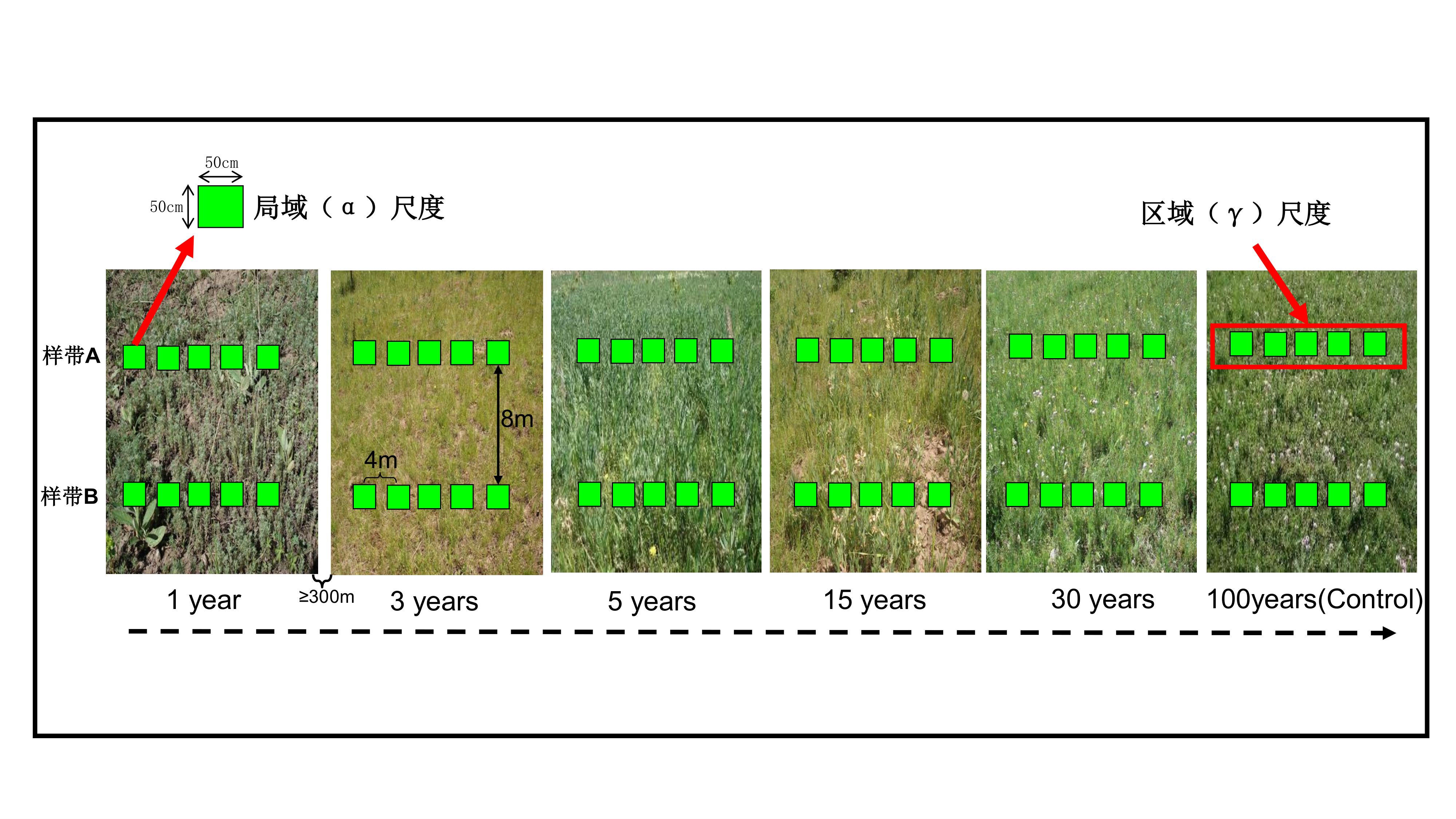
In 2003, a time series of successional restoration experiments was conducted on the western slopes of Gannan Cooperative using a spatial alternative to temporal approach, in which abandoned cultivated land of 1 year, 3 years, 5 years, 15 years, and 30 years and a natural control were selected to form a time series of successional restoration experiments, and a community survey of biomass, multiplicity, and height as well as an analysis of soil nutrients were conducted at the beginning of August of each year. This provides an ideal experimental platform to study the mechanism of alpine meadow community construction and the process of biodiversity and ecosystem functioning. At present, the experiment has obtained continuous observation data for nearly 10 years, and the relevant results have been published in Journal of Ecology, Land Degradation & Development and so on.
Biodiversity loss simulation experiment (2012-present)
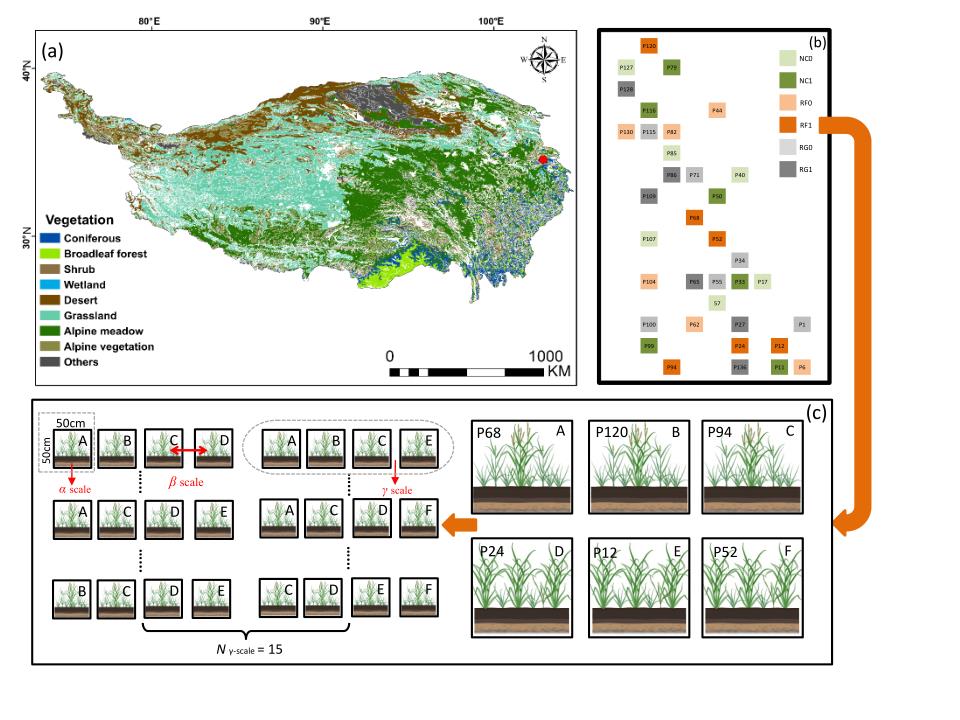
In 2012, 132 fixed sample plots were deployed at the Cooperative Experimental Station of Alpine Meadow and Wetland Ecosystems of Lanzhou University, and 13 treatments, including different plant functional groups and dominant species, were excluded under the background of simulated nitrogen deposition. This provides an ideal experimental platform for us to further examine the ecological functions of key species or functional groups, such as pre-successional and post-successional species, found in the succession experiments of abandoned cropland, as well as to examine the impacts of the loss of different plant functional groups and dominant species on the ecosystems of alpine meadows, and to examine the interactions between species or functional groups.
Selected publications from this experiment:
- Zhou, X. et al. (2026). Dominant grasses, not subordinate forbs, sustain ecosystem multifunctionality across spatial scales. [PDF]
- Li, W. et al. (2022). Nitrogen deposition magnifies destabilizing effects of plant functional group loss. [DOI]
- Li, W. et al. (2018). Effect of loss of plant functional group and simulated nitrogen deposition on subalpine ecosystem properties on the Tibetan Plateau. [DOI]
Experiments on plant-herbivore mutualism (2017-present)
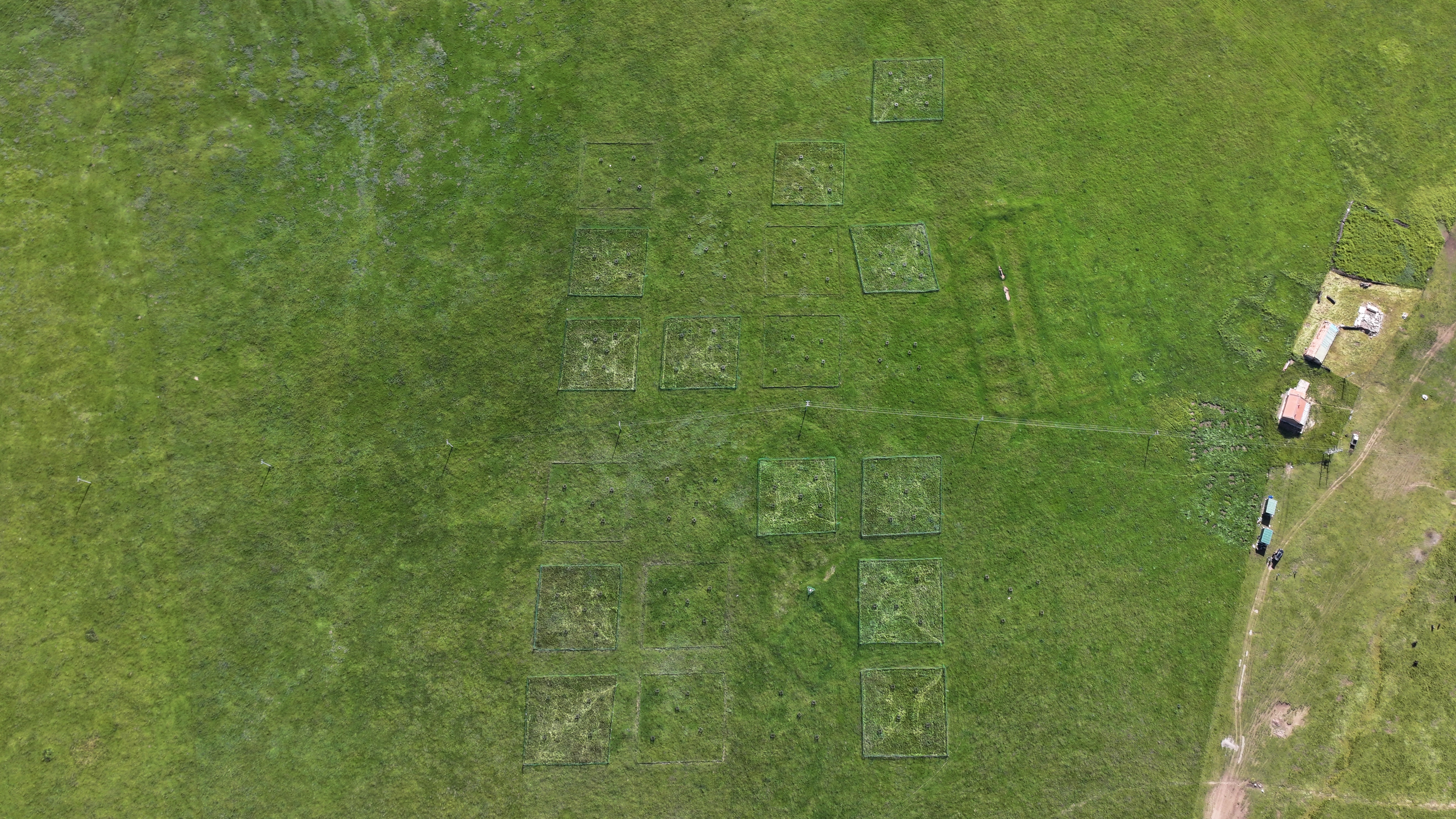
Herbivores are one of the most common disturbers in grassland ecosystems. Herbivores (herbivores) directly or indirectly affect grassland diversity and productivity through activities such as feeding, trampling, digging and faecal excretion, which in turn affect ecosystem functions (e.g. nutrient cycling, organic matter decomposition and microbial activity), which in turn affect the productivity and diversity of grassland ecosystems, and consequently the quantity and quality of herbivores. Therefore, the interface between herbivores and plants (diversity) can form a ‘two-way feedback loop’ that plays a key role in the stability of grassland grazing systems.In 2016, we investigated the plant diversity and productivity of alpine meadows in Henan County, Qinghai Province, China, in different years of enclosure, and set up an exclusion experiment of above-ground and below-ground herbivores, with the aim of Examine the role and influence of herbivores in maintaining plant diversity in alpine meadows, and examine the ecological function of Tibetan Plateau rodents (plateau zokors and pikas) in alpine ecosystems, to provide internationally recognised scientific evidence for the claim that overgrazing and rodent infestation are the main factors causing grassland degradation on the Tibetan Plateau, and more importantly, to provide scientific evidence for the claim that overgrazing and rodent infestation are the main factors causing grassland degradation on the Tibetan Plateau. More importantly, it provides scientific evidence for the maintenance of plant diversity and sustainable grazing on the Tibetan Plateau. This project was conducted in collaboration with Professor Johannes M Knops, a globally renowned ecologist from the Liverpool School of Environment and Health in a long-term collaboration. During the summer sampling surveys, there will be joint learning work with ecological PhD students from the USA and UK.